-2.jpg)
It’s here 👶
For months, you’ve been dreaming about what it will be like to bring your little miracle home. What they’ll look like, what they’ll sound like, and how you’ll handle your very first days and weeks together.
Whether you already have parenting experience or this is your first time, we all share one common worry: will we be able to create the very best conditions for our baby’s healthy development from day one?
It’s no secret that the first days and weeks of a newborn’s life are considered sensitive and key for their future psychomotor development.
Everything begins with reflexes, which are a natural part of the newborn period. A baby is born with many unconditioned reflexes (they can breathe, swallow, blink, cough, etc.), which reflect the state and functioning of their nervous system.
Besides these, the newborn period is also characterized by other equally important reflexes that appear only at this stage and typically fade gradually by around 6 months.
Appropriate early conditions play an important role in how your baby will develop both in movement and neuromuscular control.
This article offers a look at what is worth monitoring, how you can support healthy development, what not to rush, and what to watch out for.
NEWBORN REFLEXES AND WHAT THEY DO
In the first weeks after birth, a baby’s psychomotor development relies mainly on basic reflexes. These include, for example:
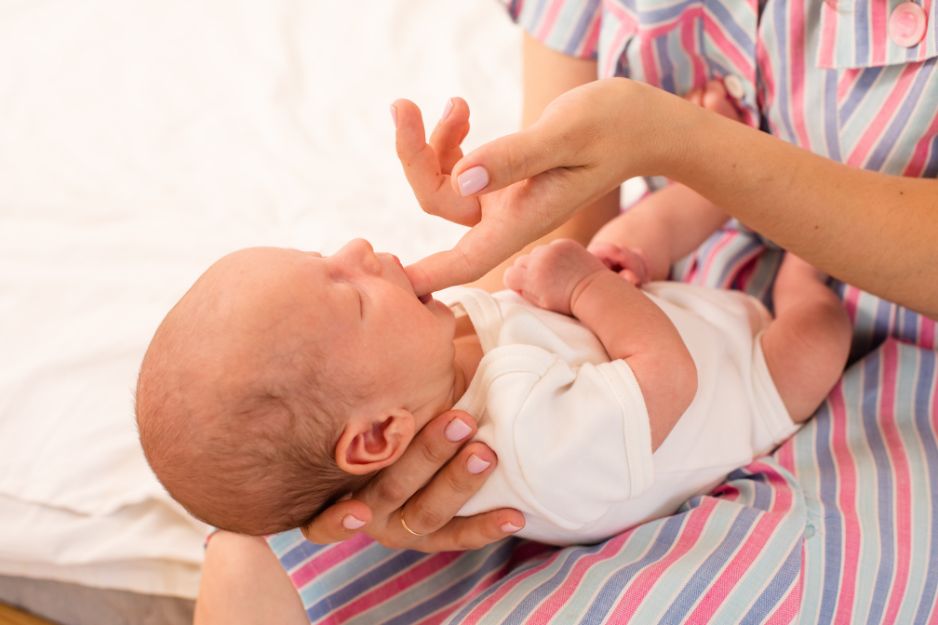
- Rooting reflex – helps a stimulating object (e.g., nipple, pacifier) find its way into the mouth.
- Sucking reflex – the baby responds to stimulation of the lips or mouth by sucking.
- Orienting reflex – the baby turns the head toward the direction of touch.
- Doll’s eye phenomenon – when the newborn’s head is turned left or right, the eyes move in the opposite direction.
- Grasp reflex – when you place a finger in the baby’s palm, they grip it firmly.
- Response to light – the baby turns the head toward the source of light.
- Moro reflex – a reaction to sudden movement or sound: the baby throws the arms out, then makes a hugging motion.
These reflexes gradually fade during the first months of life and are replaced by so-called controlled movements. If some reflexes are missing, or if they persist beyond the expected developmental stage, it may signal an issue in ongoing development – as stated by neonatologist MUDr. Katarína Golianová from Zvolen Hospital in this article: link.
SENSES: A FOUNDATION FOR LIFE
Many parents have lots of questions when their baby is born. One of them concerns the senses. Can they see us? Can they hear us? If your baby is born healthy, the answer is simple: yes. They see, hear, and feel.
As early as the seventh month of pregnancy, all of the baby’s senses begin developing in the womb. They are not at their maximum yet, but from birth your baby is ready to learn how to live in a new world and discover it through their senses. It is important that their senses are stimulated appropriately and sufficiently.
Otherwise, it may have a negative impact on their psychomotor development.
Here are a few tips to help your baby connect with the environment:
1. TOUCH – the very first sense to develop. Babies use it already in the womb: they kick, touch themselves and their mother, and move. After birth, they want to be comforted by touch, stroked, hugged, tickled, carried in arms.
Children who receive fewer touches early in life may be more prone to emotional difficulties in adulthood. You can stimulate touch by alternating different surfaces and materials: stroke your baby with soft fabric, tickle with a feather, gently massage with warm hands, and place them on play mats and play simple finger games.
2. VISION – did you know a newborn doesn’t see in full color yet? They typically begin seeing colors and objects at greater distances around 4 to 6 months. Up to about two months, babies are most interested in human faces; later their attention expands to objects.
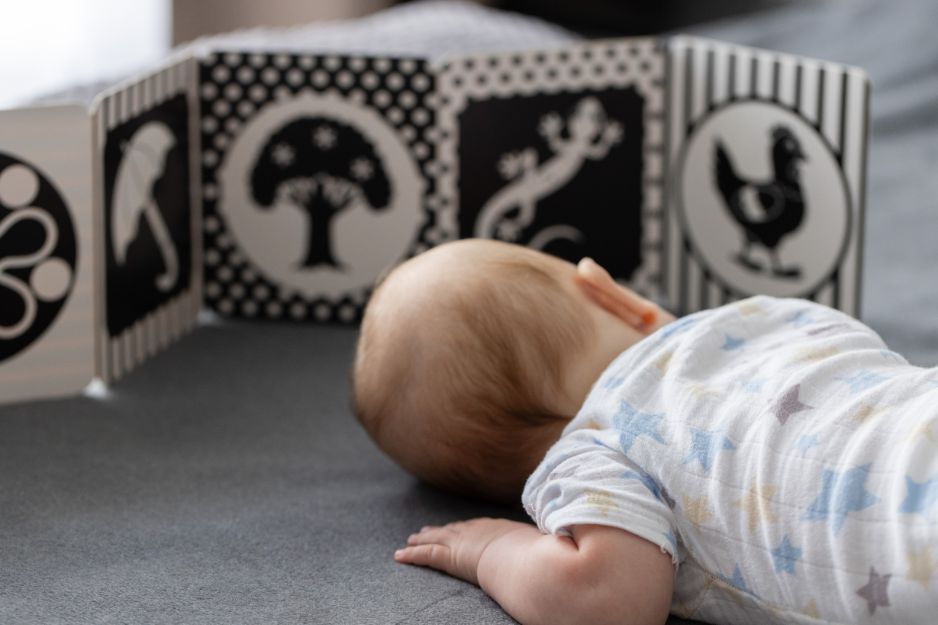
At first, your newborn will appreciate the presence of a familiar face (mom, dad). You can also stimulate visual perception with high-contrast black-and-white patterns or geometric shapes, or shiny objects, moving them slowly in front of the eyes at a distance of about 20 to 25 cm.
3. HEARING - even before birth, babies start hearing sounds around the 18th week in the womb (music, voices, the mother’s heartbeat, etc.). After birth, they tend to prefer the higher, calmer voice of the mother over the deeper voice of the father. Talk to your baby calmly and gently, and use soft sound stimulation: sound toys and simple lullabies.
4. SMELL – did you know a newborn’s sense of smell can be stronger than an adult’s in certain ways? Babies love the scent of their mother and breast milk, and for the first 6 months that scent is often enough for them. When it comes to milk, they may even prefer the smell of another woman’s breast milk over formula.
5. TASTE – the first taste buds form as early as the 8th week after conception, and because the baby is closely connected to the mother, they also begin building a relationship to the tastes of foods the mother eats. Newborns can distinguish sweet, sour, and bitter tastes. The last two may trigger grimacing or crying.
Babies prefer sweet taste, and breast milk tastes sweet too. It contains carbohydrates that can trigger endorphin production. Babies usually start recognizing salty taste around 4 months. The World Health Organization WHO recommends exclusive breastfeeding for the first 6 months.
The period between 6 and 12 months is sometimes called a biological window for developing taste preferences. Babies are more receptive and open to new flavors and textures. Even if you meet initial resistance, it’s important to help your baby get used to the natural taste of food without added sugar and salt.
Sharpen your baby’s senses playfully and without pressure.
You may find you’ve forgotten many scents, textures, and tastes and it can be surprisingly nice to rediscover them. You might even remember your own childhood.
Explore your baby’s senses in a relaxed, playful way and keep an eye on their mood. Everything has its time and goes more easily when basic needs are met: your baby isn’t hungry or thirsty, has a dry diaper, isn’t in pain, and feels safe.
THE MYSTERIOUS LANGUAGE OF BABIES
A newborn is a little personality who sends signals right from birth. They show what they like and what they don’t, and communicate whether they’re hungry, tired, wet, and so on. Learning to interpret these signals is one of the first parenting challenges. It takes time and practice to understand crying, facial expressions, and body language.
Did you know a baby’s face has up to 25 muscles that are interconnected and controlled by the cerebral cortex? That’s why babies can express emotions in roughly this order:
- from birth: interest, distress, fear
- from 6 weeks: joy and happiness
- from 3 months: surprise, anger
- from 5 months: fear, disgust, aversion to odors, embarrassment
- from 9 months: boredom, anxiety, anticipation
It is completely normal for a newborn to cry if they’re hungry, in pain, have a wet diaper, feel too hot, or too cold.
Before you become an expert at decoding this universal language, Mgr. Iveta Sedláčková, head nurse at the neonatal department in Penta Hospitals, recommends trying the so-called elimination method.
By gradually ruling out possibilities (hunger, wet or dirty diaper, need for cuddling, room too warm or too cold, etc.), you can identify your baby’s current need or problem.

As babies get older, crying can express fear, frustration, sleepiness, a need for attention, or overstimulation.
TUMMY TIME
Tummy time is absolutely key for a newborn. It helps strengthen the neck, back, and shoulder muscles needed for healthy, controlled movement later on. If your baby doesn’t have any health issues, they should start tummy time already within the first week after birth. Here’s how to do it:
- Start with short but frequent intervals: place your baby on their tummy for 1 to 2 minutes several times a day.
- You can begin with tummy time on your chest, on your belly, using a nursing pillow, or on a play mat such as LALALU.
- Always use comfortable, soft, and safe surfaces and vary them throughout the day.
- Encourage lifting and turning the head using toys, sounds, your voice, or a mirror.
- Stay close and supervise tummy time at all times.

If your baby doesn’t like tummy time, don’t panic. Help them get used to it slowly and gradually increase the time. Think back to your first time at the gym or a CrossFit class :)
It wasn’t easy either, right? With repetition you adapted to a new load, and the reward was joy in movement. Babies are similar, they just can’t tell us yet.
WHEN TO PAY EXTRA ATTENTION
Psychomotor development is a complex process that includes not only motor skills (movement) but also emotional, cognitive, and social development. While every child develops at their own pace, there are milestones that can help parents orient themselves. That’s why certain signals shouldn’t be overlooked:
Warning signs in newborns (0 to 2 months):
-
No reaction to loud sounds:
A newborn should react to loud sounds by startling, moving, or blinking. If such reactions are absent, it may indicate a hearing issue. -
Weak or missing sucking reflex:
If the baby cannot suck or swallow effectively, it may point to a neuromuscular issue or nervous system immaturity. -
Very low activity:
A newborn should move arms and legs. If the baby is passive, moves very little, or shows minimal movements, it may be concerning. -
Persistent asymmetry of the head or body:
If the baby consistently keeps the head turned to one side or the body appears asymmetrical, it may suggest muscle tightness or a spine issue. -
No eye contact:
If the baby does not begin to maintain eye contact around 6 weeks, it may be a sign of vision or neurological concerns. -
Unusual or very weak crying:
A newborn’s cry should be strong and clear. A weak, hoarse, or very unusual cry may signal a problem with breathing, muscle tone, or overall health. -
Persistent seizures or jerky movements:
Irregular rhythmic twitching or spasms can be a sign of a neurological problem.

Warning signs in babies (3 to 6 months):
-
Doesn’t lift the head during tummy time:
Many babies can lift their head while on the tummy around 1 month. If the baby still can’t do it by 3 months, it may indicate muscle weakness or delayed motor development. -
Doesn’t turn toward sounds or voices:
If the baby does not react to familiar sounds or voices (e.g., a parent’s voice), it may signal a hearing issue. -
No smiling or social interaction:
Babies often respond with a smile around 6 weeks. If this doesn’t happen by 3 months, it may be a warning sign. -
Cannot track objects with the eyes:
If the baby can’t track moving objects by 3 months or their eyes frequently drift, it may indicate a vision issue. -
Doesn’t turn the head toward sounds or movement:
Babies should be able to turn their head toward sound or movement. If not, it may indicate delayed development. -
Persistent newborn reflexes:
Reflexes such as the Moro reflex usually fade by around 4 months. If they persist, it may signal a neurological issue. -
Doesn’t hold toys or grasp objects:
Around 4 months, babies often begin grasping objects. If not, it may be a sign of delayed fine motor skills. -
Doesn’t roll from tummy to back (or vice versa):
By 5 to 6 months, many babies start rolling. If the baby remains inactive, it may indicate muscle weakness. -
Very stiff or very floppy muscles:
If the baby’s body feels very stiff, or unusually floppy and unable to support itself during handling, it may indicate nervous system or muscle issues. -
Poor weight gain or developmental stagnation:
The baby isn’t gaining weight, shows no progress in motor skills, or seems apathetic.
If you notice any of these signs, it’s important to consult a specialist, such as your pediatrician or a pediatric physiotherapist.
Small Steps Toward Healthy Development
The first weeks of your baby’s life are full of small but incredibly important steps. Your support and attention help build strong foundations for healthy psychomotor development. Remember: every baby, including yours, is unique, and your patience and love are the best gifts you can give.
Yours, LALALU